The cross-math solving method in five steps
Use the same loop on every board. The first move comes from the tightest equation; each placement then creates the information for the next move.
- Scan for the equation with the fewest empty cells. Start with one unknown whenever possible.
- Calculate the missing value. Use the inverse operation instead of testing tiles at random.
- Check every crossing. The number must satisfy each equation that touches its cell, not just the first one you noticed.
- Place the forced tile, then immediately re-read the equations crossing that cell. One of them may now have a single unknown.
- Repeat the cascade. If no equation has one unknown, use operator constraints and the remaining tray to eliminate candidates.
What a cross-math puzzle asks
A cross-math puzzle is a grid of cells joined by arithmetic. Some cells already hold numbers; others are empty. Around the board sit operators — plus, minus, times, divide — and equals signs that tie short chains of cells into equations. You are given a small tray of number tiles, and your task is to place every tile so that each equation on the board reads true at the same time.
The key word is "at the same time." A tile that satisfies one equation has to also fit every other equation it touches. That overlap is what turns arithmetic into a logic puzzle: the right number for a cell is rarely a matter of taste, it is forced by everything around it.
Worked example: one forced move unlocks the next
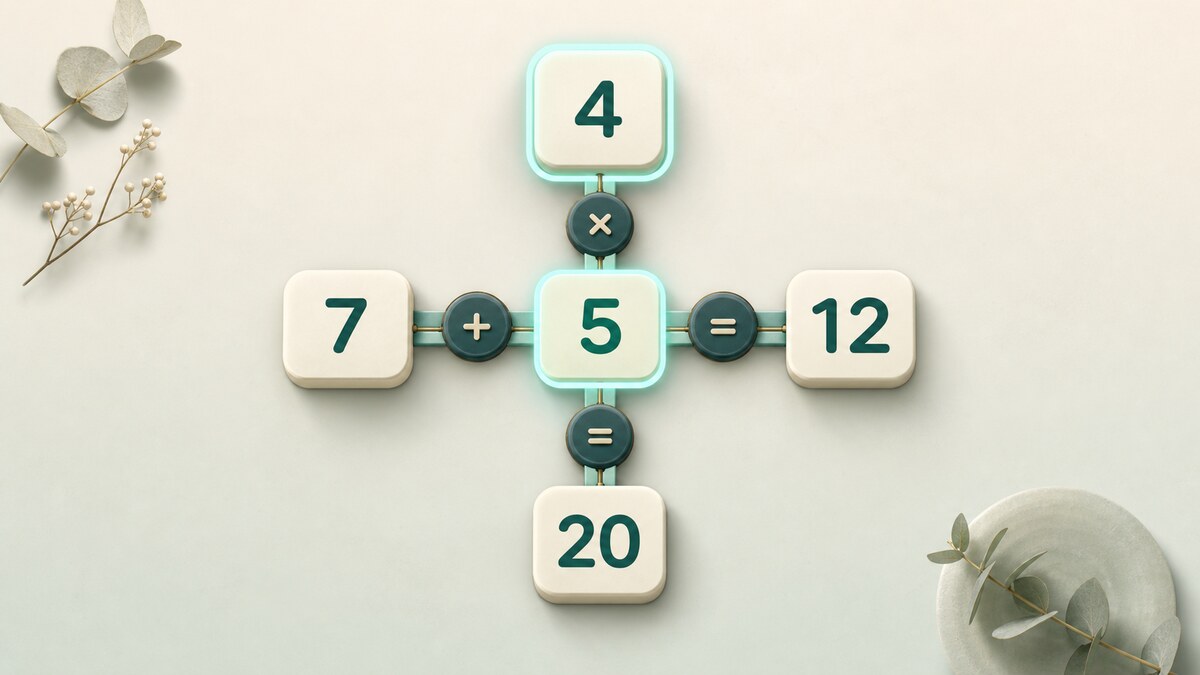
Suppose the tray holds 4 and 5. In the top equation, 7 plus A equals 12, so A must be 5. That placement immediately turns the crossing into 5 times B equals 20, which forces B to be 4.
You did not test either tile. One exact equation forced A, and the crossing carried that information into the next equation. That chain reaction is the cascade you will use across a full board.
7 + [ A ] = 12
      ×
    [ B ]
      =
      20

Tile tray: 4, 5
Try the method on today's free puzzleUse each operator as a constraint
Operators narrow the field faster than the numbers do. If a chain multiplies to a small product, the factors are limited. If a difference is large, one of the two cells has to be large and the other small. Division is the strongest clue of all: a ÷ b that must come out whole tells you b divides a, which often leaves only one candidate in your tray.
Train yourself to ask "what does this operator forbid?" rather than "what could go here?" Forbidding candidates is faster than testing them, and it is exactly how the puzzle was designed to be read.
Count the tiles that remain
Your tray is finite, and that is a clue in itself. If three cells still need filling and your tray holds a 3, a 6, and a 9, then those three numbers go into those three cells — the only question is which goes where, and the equations decide that. Keeping an eye on what's left in the tray often collapses a daunting board into a handful of forced placements.
What to do when you get stuck
If you find yourself thinking "I'll try this and see," stop. Every Lattice puzzle is machine-proven to have exactly one solution, which means a guess is never required — the next move is always deducible from what's on the board. When you're stuck, you haven't run out of logic; you've missed a clue. Re-scan for the equation with the fewest unknowns and start the cascade again.
If no equation has one empty cell, list the candidates allowed by the tightest product, division, difference, or sum. Cross out any candidate that fails a crossing equation or is no longer in the tray. For a deeper example of that technique, continue with the worked Master solve.